

初入Rust吧
fn main() {
    println!("hello world");
}
进行编译调试的时候就是执行
rustc main -o main这样就可以实现获取得到最终的结果了吧,还是比较简单的讷
初入cargo
cargo 是rust 的一个包管理工具和包管理器吧,大多数的 rust 都是使用 cargo 来进行创建项目和管理项目的讷
cargo new project_name
核心需要关注的就是 Cargo.toml 吧
[package]
name = "hello_cargo"
version = "0.1.0"
edition = "2021"

[dependencies]
cargo build 和 cargo run 以及 cargo build --release 是十分关键的讷
猜数字游戏
/// 开始书写自己的一个猜数字的游戏吧
use std::io; // 引入 io 模块

fn main() {
    println!("guessing game begining...");

    let mut guess = String::new();  // 定义一个可变的字符串,后续是需要接收用户输入的,所以说是可变的吧

    io::stdin()
        .read_line(&mut guess)
        .expect("Failed to read line");

    println!("You guess: {}", guess);
}
步骤:先获取得到用户的输入输出
这里必须是一个可变的字符串吧,因为需要做的是进行对应的接受到用户的输入输出吧,以及读取得到命令行的输入进行赋值给可变的变量即可吧
以及这里面的细节还有
1. 可变变量的定义
2. rust 打印的格式化输出
3. 错误断言的兜底操作吧
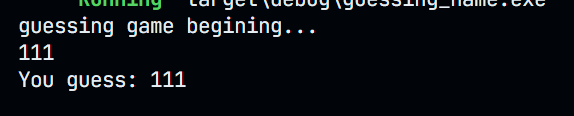
但是现在的功能还是很少的,远远不是我们想要的猜数字的游戏吧
此时需要一个随机数的包 crate 吧,这里就是
rand: 0.8.3
use rand::Rng;
use std::cmp::Ordering;
use std::io;

fn main() {
    println!("Guess the number!");

    let secret_number = rand::thread_rng().gen_range(1..101);

    loop {
        println!("Please input your guess.");

        let mut guess = String::new();

        io::stdin()
            .read_line(&mut guess)
            .expect("Failed to read line");

        /// 进行对用户的输入进行清洗一下啊,确保正确性吧
        let guess: u32 = match guess.trim().parse() {
            Ok(num) => num,
            Err(_) => continue,
        };

        println!("You guessed: {}", guess);

        match guess.cmp(&secret_number) {
            Ordering::Less => println!("Too small!"),
            Ordering::Greater => println!("Too big!"),
            Ordering::Equal => {
                println!("You win!");
                break;
            }
        }
    }
}
Rust 通用性编程思想
变量和可变性
rust 定义的变量默认是不可变的讷,但是是可以通过添加关键字来实现对应的创建可变变量讷
let variable = value这就是创建的不可变的变量吧let mut variable = value这就是创建的可变的变量吧
常量
与不可变变量类似,常量(constant)是绑定到一个常量名且不允许更改的值,但是常量和变量之间存在一些差异
首先,常量不允许使用
mut。常量不仅仅默认不可变,而且自始至终不可变。常量使用const关键字而不是let关键字来声明,并且值的类型必须注明常量可以在任意作用域内声明,包括全局作用域,这对于代码中很多部分都需要知道一个值的情况特别有用。
最后一个不同点是常量只能设置为常量表达式,而不能是函数调用的结果或是只能在运行时计算得到的值。
const THREE_HOURS_IN_SECONDS: u32 = 60 * 60 * 3;数据类型
rust 的每个值都是确切的数据类型吧,该类型告诉 rust 数据是被定义成了什么数据类型,从而让rust知道如何使用该数据吧
基本数据类型:整型、浮点型、字符类型、布尔类型
核心关注的是符合数据类型:元组类型,数组类型、
控制流
fn main() {
    let number = 3;

    if number < 5 {
        println!("condition was true");
    } else {
        println!("condition was false");
    }
}
fn main() {
loop {
println!("again!");
}
}fn main() {
let mut count = 0;
'counting_up: loop {
println!("count = {}", count);
let mut remaining = 10;
loop {
println!("remaining = {}", remaining);
if remaining == 9 {
break;
}
if count == 2 {
break 'counting_up;
}
remaining -= 1;
}
count += 1;
}
println!("End count = {}", count);
}fn main() {
let mut counter = 0;
let result = loop {
counter += 1;
if counter == 10 {
break counter * 2;
}
};
println!("The result is {}", result);
}fn main() {
let mut number = 3;
while number != 0 {
println!("{}!", number);
number -= 1;
}
println!("LIFTOFF!!!");
}fn main() {
let a = [10, 20, 30, 40, 50];
for element in a {
println!("the value is: {}", element);
}
}Rust 所有权
所有运行的程序都必须管理其使用计算机内存的方式。一些语言中具有垃圾回收机制,在程序运行时不断地寻找不再使用的内存;在另一些语言中,开发者必须亲自分配和释放内存。Rust 则选择了第三种方式:通过所有权系统管理内存,编译器在编译时会根据一系列的规则进行检查。在运行时,所有权系统的任何功能都不会减慢程序
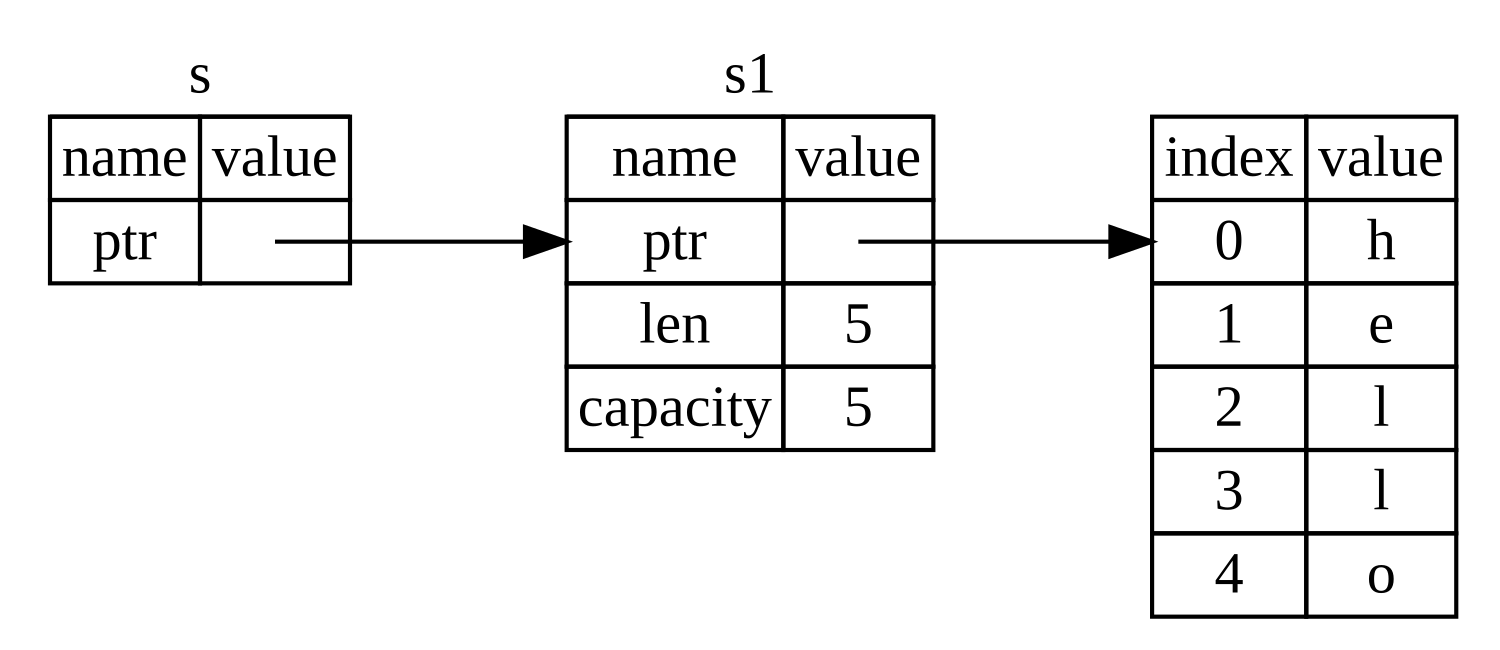
fn main() {
    let s1 = String::from("hello");

    let len = calculate_length(&s1);

    println!("The length of '{}' is {}.", s1, len);
}

fn calculate_length(s: &String) -> usize {
    s.len()
}
Rust 结构体
struct User {
    active: bool,
    username: String,
    email: String,
    sign_in_count: u64,
}

fn main() {
    let mut user1 = User {
        email: String::from("someone@example.com"),
        username: String::from("someusername123"),
        active: true,
        sign_in_count: 1,
    };

    user1.email = String::from("anotheremail@example.com");
}

fn build_user(email: String, username: String) -> User {
    User {
        email: email,
        username: username,
        active: true,
        sign_in_count: 1,
    }
}
struct Color(i32, i32, i32);
struct Point(i32, i32, i32);
fn main() {
let black = Color(0, 0, 0);
let origin = Point(0, 0, 0);
}fn main() {
let rect1 = (30, 50);
println!(
"The area of the rectangle is {} square pixels.",
area(rect1)
);
}
fn area(dimensions: (u32, u32)) -> u32 {
dimensions.0 * dimensions.1
}struct Rectangle {
width: u32,
height: u32,
}
fn main() {
let rect1 = Rectangle {
width: 30,
height: 50,
};
println!(
"The area of the rectangle is {} square pixels.",
area(&rect1)
);
}
fn area(rectangle: &Rectangle) -> u32 {
rectangle.width * rectangle.height
}/// 通过派生 trait 增加实用功能
#[derive(Debug)]
struct Rectangle {
width: u32,
height: u32,
}
fn main() {
let rect1 = Rectangle {
width: 30,
height: 50,
};
println!("rect1 is {:?}", rect1);
}impl Rectangle {
fn width(&self) -> bool {
self.width > 0
}
fn area(&self) -> u32 {
self.width * self.height
}
fn can_hold(&self, other: &Rectangle) -> bool {
self.width > other.width && self.height > other.height
}
fn square(size: u32) -> Rectangle {
Rectangle {
width: size,
height: size,
}
}
}
impl Rectangle {
fn area(&self) -> u32 {
self.width * self.height
}
}
impl Rectangle {
fn can_hold(&self, other: &Rectangle) -> bool {
self.width > other.width && self.height > other.height
}
}
fn main() {
let rect1 = Rectangle {
width: 30,
height: 50,
};
if rect1.width() {
println!("The rectangle has a nonzero width; it is {}", rect1.width);
}
}Rust 枚举和模式匹配
enum IpAddrKind {
    V4,
    V6,
}

let four = IpAddrKind::V4;
let six = IpAddrKind::V6;


fn route(ip_type: IpAddrKind) { }

route(IpAddrKind::V4);
route(IpAddrKind::V6);


enum IpAddrKind {
    V4,
    V6,
}
struct IpAddr {
    kind: IpAddrKind,
    address: String,
}
let home = IpAddr {
    kind: IpAddrKind::V4,
    address: String::from("127.0.0.1"),
};
let loopback = IpAddr {
    kind: IpAddrKind::V6,
    address: String::from("::1"),
};
enum Coin {
Penny,
Nickel,
Dime,
Quarter,
}
fn value_in_cents(coin: Coin) -> u8 {
match coin {
Coin::Penny => 1,
Coin::Nickel => 5,
Coin::Dime => 10,
Coin::Quarter => 25,
}
}
fn value_in_cents(coin: Coin) -> u8 {
match coin {
Coin::Penny => {
println!("Lucky penny!");
1
}
Coin::Nickel => 5,
Coin::Dime => 10,
Coin::Quarter => 25,
}
}#[derive(Debug)] // 这样可以立刻看到州的名称
enum UsState {
Alabama,
Alaska,
// --snip--
}
enum Coin {
Penny,
Nickel,
Dime,
Quarter(UsState),
}
fn value_in_cents(coin: Coin) -> u8 {
match coin {
Coin::Penny => 1,
Coin::Nickel => 5,
Coin::Dime => 10,
Coin::Quarter(state) => {
println!("State quarter from {:?}!", state);
25
}
}
}/// 我们在之前的部分中使用 Option<T> 时,是为了从 Some 中取出其内部的 T 值;我们还可以像处理 Coin 枚举那样使用 match 处理 Option<T>!只不过这回比较的不再是硬币,而是 Option<T> 的成员,但 match 表达式的工作方式保持不变
fn plus_one(x: Option<i32>) -> Option<i32> {
match x {
None => None,
Some(i) => Some(i + 1),
}
}
let five = Some(5);
let six = plus_one(five);
let none = plus_one(None);use hello::ThreadPool;
use std::io::prelude::*;
use std::net::TcpListener;
use std::net::TcpStream;
use std::fs;
use std::thread;
use std::time::Duration;
fn main() {
let listener = TcpListener::bind("127.0.0.1:7878").unwrap();
let pool = ThreadPool::new(4);
for stream in listener.incoming().take(2) {
let stream = stream.unwrap();
pool.execute(|| {
handle_connection(stream);
});
}
println!("Shutting down.");
}
fn handle_connection(mut stream: TcpStream) {
let mut buffer = [0; 1024];
stream.read(&mut buffer).unwrap();
let get = b"GET / HTTP/1.1\r\n";
let sleep = b"GET /sleep HTTP/1.1\r\n";
let (status_line, filename) = if buffer.starts_with(get) {
("HTTP/1.1 200 OK\r\n\r\n", "hello.html")
} else if buffer.starts_with(sleep) {
thread::sleep(Duration::from_secs(5));
("HTTP/1.1 200 OK\r\n\r\n", "hello.html")
} else {
("HTTP/1.1 404 NOT FOUND\r\n\r\n", "404.html")
};
let contents = fs::read_to_string(filename).unwrap();
let response = format!("{}{}", status_line, contents);
stream.write(response.as_bytes()).unwrap();
stream.flush().unwrap();
}use std::thread;
use std::sync::mpsc;
use std::sync::Arc;
use std::sync::Mutex;
enum Message {
NewJob(Job),
Terminate,
}
pub struct ThreadPool {
workers: Vec<Worker>,
sender: mpsc::Sender<Message>,
}
type Job = Box<dyn FnOnce() + Send + 'static>;
impl ThreadPool {
/// 创建线程池。
///
/// 线程池中线程的数量。
///
/// # Panics
///
/// `new` 函数在 size 为 0 时会 panic。
pub fn new(size: usize) -> ThreadPool {
assert!(size > 0);
let (sender, receiver) = mpsc::channel();
let receiver = Arc::new(Mutex::new(receiver));
let mut workers = Vec::with_capacity(size);
for id in 0..size {
workers.push(Worker::new(id, Arc::clone(&receiver)));
}
ThreadPool {
workers,
sender,
}
}
pub fn execute<F>(&self, f: F)
where
F: FnOnce() + Send + 'static
{
let job = Box::new(f);
self.sender.send(Message::NewJob(job)).unwrap();
}
}
impl Drop for ThreadPool {
fn drop(&mut self) {
println!("Sending terminate message to all workers.");
for _ in &mut self.workers {
self.sender.send(Message::Terminate).unwrap();
}
println!("Shutting down all workers.");
for worker in &mut self.workers {
println!("Shutting down worker {}", worker.id);
if let Some(thread) = worker.thread.take() {
thread.join().unwrap();
}
}
}
}
struct Worker {
id: usize,
thread: Option<thread::JoinHandle<()>>,
}
impl Worker {
fn new(id: usize, receiver: Arc<Mutex<mpsc::Receiver<Message>>>) ->
Worker {
let thread = thread::spawn(move ||{
loop {
let message = receiver.lock().unwrap().recv().unwrap();
match message {
Message::NewJob(job) => {
println!("Worker {} got a job; executing.", id);
job();
},
Message::Terminate => {
println!("Worker {} was told to terminate.", id);
break;
},
}
}
});
Worker {
id,
thread: Some(thread),
}
}
}